Showing posts with label Vladimir Putin. Show all posts

Thursday, 31 July 2014

The rest of the story

As a president, Vladimir Putin would soon show that he had not forgotten about the working methods of the good old KGB. The most notable examples are the lawsuits against Mikhail Khodorkovsky (°Moscow, 20/06/1963) and Platon Lebedev (°Moscow, 29/11/1956), the former owners of the oil company Yukos. Khodorkovsky was a successful business man and known by his criticism of corruption in the Russian polity, and also by his commitment to openness with his movement Открытая Россия (Otkrytaya Rossiya) or Open Russia, and by his support to opposition parties.

In 2003, Khodorkovsky and Lebedev were arrested on suspicion of tax evasion, fraud and embezzlement. Yukos got completely dismantled, and the most profitable parts were given to Rosneft, an oil company run by Igor Setshin (°Leningrad, 07/09/1960). Setshin is a former KGB spy and one of the most conservative advisors of Putin. He was Deputy Prime Minister in the cabinet of Putin and leader of the Комманда Силовиков (Kommanda Silovikov) or The Men of Power, a lobby of former KGB agents - and thus friends of Putin - in the Kremlin.

In an attempt to reduce the public interest for the trial, it was held in the less significant Meshchansky district court in Moscow. Behind the scenes, however, the Kremlin and the Moscow City Court, the supreme court of the city of Moscow, played a guiding role. On May 31, 2005, Khodorkovsky and Lebedev were convicted for tax evasion and fraud to 9 years imprisonment. On September 22, 2005, in a session of one day, the verdict was upheld on appeal, but the sentence was reduced to 8 years.

Since there was a reasonable chance that Khodorkovsky and Lebedev would be released on parole before the presidential elections of 2012, and thus possibly could disrupt Putin's second presidential election, new "allegations" emerged, and a second trial against them was staged. This time they were accused of the theft of 350 million tons of oil. Besides the fact that this is physically rather impossible, it appeared that judge Viktor Danilkin (°1957) was regularly "adjusted" by the Kremlin during the trial. Danilkin struggled with the sometimes absurd accusations and had to be regularly "updated".

Natalya Vasilyeva, the assistant of judge Danilkin, testified on February 14, 2011, that the judge had prepared his verdict to be delivered on December 16, 2010. On December 15, however, the deliverance was postponed for unknown reasons to December 27. On December 16, it became clear why: That day, Putin delivered a controversial speech in which he said that Khodorkovsky was a thief and therefore should be stay in prison. Vasilyeva testified that the original judgment of Danilkin had been changed and that he had delivered the new verdict against his will. As a result of this adjusted verdict, Khodorkovsky and Lebedev can not be released before August 2014.

In 2011, the then Russian President Dmitry Medvedev asked the Kremlin Human Rights Council to investigate the Khodorkovsky case further. The Council concluded that Khodorkovsky and Lebedev were innocent. It did not lead to a release. On the contrary, the nine members of the Council were accused of being bribed. Five of them were the subject of interrogations and prosecutions. Some lost their jobs or had to go abroad. In addition, a third case against Khodorkovsky and Lebedev was being prepared.

In the run up to the Olympic Winter Games of 2014 in Sochi, a project in which Putin wanted to shine in the eyes of the world, many world leaders had announced that they would not attend the ceremonies. Real reasons were not given, but it was clear that the way in which human rights were violated in Russia was at the basis of it. Especially the arrest of 30 Greenpeace activists a few months earlier, the Khodorkovsky case and the Russian anti gay law were an eyesore. On December 17, 2013, U.S. President Barack Obama said he would not come himself to Sochi. As members of the delegation which would represent him, he appointed two notorious gay people: tennis legend Billie Jean King and hockey player Caitlin Cahow. According to the American-Russian journalist Masha Gessen, Putin loomed for the specter to see himself accompanied by "only the Ukrainian president and two American gays" at the opening of his personal prestige project. On December 19, 2013, Putin unexpectedly announced that Mikhail Khodorkovsky could be released, which happened the next day. On December 20, 2013, Khodorkovsky arrived as a free man in Berlin. According to Putin, he can freely return to Russia, but whether that will ever happen is doubtful, as the investigations for a possible third trial have not been put on hold.

On July 28, 2014 Russia was condemned by the Permanent Court of Arbitration in The Hague for the way Mikhail Khodorkovsky and Yukos were treated. Besides the fact that Russia was sentenced to a very severe damages of $ 50 billion, the Court was also very hard in its motivation. The dismantling of Yukos was politically motivated, with the aim to push the company towards bankruptcy to take its assets and transfer them to state owned enterprises and to silence politically the CEO of the company, Mikhail Khodorkovsky.

It is the largest ever compensation awarded by the Court in The Hague: it is 20 times larger than the second largest, and does not even take into account complaints from minority shareholders whose files have yet to be examined.

The consequences for Russia are huge: the sum is 11 % of the country's national currency reserves and 10 % of the government budget. Also, there will be consequences for Rosneft, the energy giant which got most of Yukos' assets, and of which BP became a minority shareholder recently. The Russians have to show the money before January 2, 2015. If they don't, interests start running. Although Russia can not appeal against the verdict, the Kremlin will try o use "all means to undo it." If the country doesn't pay, the 1958 Arbitration Convention allows the seizure of all Russian assets in 150 countries to execute the sentence.

In Putin's entourage, no one is in the least concerned. One of the people from his inner circle told the Financial Times that the verdict was unimportant in the light of the geopolitical issues with Ukraine: "There will be war in Europe. Do you really think that this case is of any importance.?"

Tuesday, 7 August 2012

Open letter by Andrei Makarevich

Vladimir Vladimirovich!

As a musician, I travel around the country constantly and I meet different people. What I want to tell you, you probably already know, but I suspect that you can not imagine the scale of the disaster.

You will of course know the word "откат" (otkat) (*). 5-6 years ago, the average otkat in the country was 30 %. We weeped, but we paid. Today it is 70 %. I even know a case in which the otkat was 95 %. The whole country knows about this situation. They know it, but they don't say anything, since a part of the population is living on bribes and can eat by it, and another (much larger) part is afraid of losing everything, even the remaining thirty percent. I know what you will say - let them go to court. But they can not go to court, mister Putin. Because our courts today have become machines to punish undesirable elements or devices to get money from plaintiffs.

Thus, the remaining 30 % of the budget can be used to strengthen the defense, to build roads, to develop industry, medicine and education and to organise the world's best Olympic Games. If the situation will change drastically in the near future, we are heading for a total disaster.

I am writing this letter to you because in our life today, no major changes are possible without your decision, your word or your intervention.p>

I do not think you can stand so indifferent to the country that chose you as president.

Andrei Makarevich

(*) Otkat ("rollback") is the term used when Russian officials expect bribes in exchange when citizens or companies want government contracts. The government officials pay the contractor performing the work or supplying the services, and expect that a portion of that money "rolls back" to them.

Wednesday, 7 March 2012

A revision of the Khodorkovsky case?

One day after the election, the outgoing Russian President Dmitry Medvedev has ordered the Attorney General to "analyze the grounds" of the judgment in the case of Mikhail Khodorkovsky, the Kremlin said in a statement. Dmitry Medvedev instructed the Attorney General Yuri Chaika "to analyze the legitimacy and validity of judgments by April, 1" related to 32 convicted persons, including Mikhail Khodorkovsky and his business partner Platon Lebedev. The outgoing president is responding to the request of the opposition who has transmitted a list of people considered as political prisoners, at a meeting on February 20.

The release of political prisoners was one of the requirements of the large opposition demonstrations in Moscow which followed the contested legislative from December 4. Imprisoned since 2003, Mikhail Khodorkovsky was sentenced in two successive trials to 13 years in prison for "tax evasion, money laundering and diversion of oil" in a case seen by many observers as a settling of accounts between the power and the businessman who had stood up against the Kremlin and had financed the opposition.

Pardon

One of Mikhail Khodorkovsky's lawyers, Karinna Moskalenko, takes the news with some reservations. "We'll see how serious the authorities' intentions are," she said, quoted by the news agency Interfax. "Khodorkovsky was sentenced illegally and they had to release him a long time ago," she said. Dmitry Medvedev had said in the past that he could not discuss Khodorkovsky's pardon since there was no written request by the condemned. In December, Putin also said that he would consider the request for a pardon if Mikhail Khodorkovsky admitted guilt, which the prisoner refuses.

Dmitry Medvedev also instructed the Minister of Justice, Aleksandr Konovanov, to explain by March 15 "why the opposition party Parnas was denied registration." The decisions Medvedev were announced after the presidential election of his predecessor and mentor Vladimir Putin, who is expected to take office in May.

Tuesday, 4 October 2011

Vasily Alexanyan died

Relatives of the former Yukos executive who was diagnosed with HIV several months after he was arrested say he has died of complications caused by AIDS. Vasily Alexanyan's family announced that he died Monday, October 3, 2011, at his home in Moscow at age 39.

Alexanyan, vice president at Russia's largest oil company, was arrested in 2006 on embezzlement and money-laundering charges.

The charges followed what was widely seen as Kremlin revenge against Mikhail Khodorkovsky, who is still serving a 13-year sentence on embezzlement and money-laundering charges.

Following the diagnosis, Alexanyan contracted tuberculosis and went nearly blind before his release on bail in 2008.

Charges against him were dropped in June 2010.

Our thoughts are going to Vasily Alexanyan's family and to all others who are deprived from their fundamental rights and their families.

Friday, 29 July 2011

Prisoner Khodorkovsky

On Friday, July 29, 2011, The Belgian TV-channel Canvas presented the story of Mikhail Khodorkovsky.

"The world didn't need to wait for the verdict of the trial to know it would be "guilty". The Russian government reserved the camps in Siberia for the enemies of the state. It's true, few people did benefit more from the collapse of the Soviet Union than Khodorkovsky. But he managed to rescue declining state enterprises and made a fortune. A fortune which implied political influence.

When Vladimir Putin apperared, he didn't like those rich entrepreneurs. Khodorkovsky had to become an example. This is the story of a very peculiar court case, with Vladimir Putin acting as the judge."


Thursday, 7 October 2010

A birthday calendar for Putin

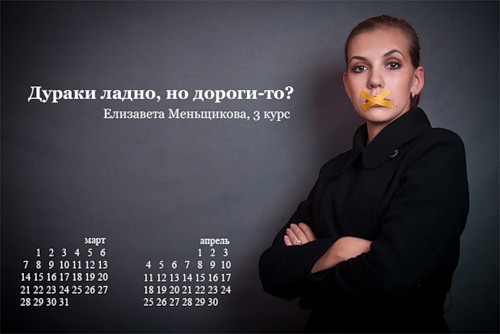
Twelve scantily clad women oozing praise for Vladimir Putin versus six stern-looking female students demanding human rights – who will win Russia's battle of the calendars?

A day after 12 journalism students at the Moscow State University, Moscow's most prestigious university, released a racy calendar in honour of Putin's 58th birthday, six of their colleagues hit back with their own version, pointing to the murders and curbs on freedom under Putin.


Vladimir Vladimirovich, we've got a few questions.


When will Khodorkovsky be freed?


Idiots, all right. But what about the roads?


(In Russia there is a saying: "There are two kinds of problems: the idiots and the roads".)


How will inflation affect the bribes?


Freedom of meeting always and everywhere?


Who killed Anna Politkovskaya?


(Anna Politkovskaya was a Russian journalist who got murdered on Putin's birthday in 2006.)


When will be the next terrorist attack?


Do you really want to know what the other calendar looked like? Alright then, but I will not translate all the praise. The title is "We love you", and further you can read stuff like: "What about your third term?", "Can I be your co-pilot?" and "You put out the fires, but I'm still burning"... Yes, that comes from journalism students at the Moscow State University. Would you believe that I also took lessons in that institute...